Stranded in the Holy Land: The Cruel Irony When Pilgrims Desperately Want to Leave the Place Millions Dream of Reaching
By: Javid Amin| 24 October 2026
The Prayer That Millions Carry — and the Irony That Few Speak Of
Somewhere right now, an old man in a small town is sitting after Fajr prayer, his prayer beads turning slowly between his fingers, whispering a du’a he has whispered ten thousand times before.
“Ya Allah. Grant me the chance to see your House. And if it is your will — call me home from there.”
He is not alone. Across a billion households — in the valleys of Kashmir, the plains of Bihar, the streets of Cairo, the villages of Indonesia, the townships of South Africa, the suburbs of Manchester — this prayer rises quietly every morning. The wish to visit Mecca or Madinah. The deeper wish, for those whose faith runs bone-deep, to die there. To take one’s last breath within the sound of the Adhan from the Prophet’s Mosque. To be lowered into the earth that prophets walked upon.
It is perhaps the most universally shared aspiration in the Muslim world — this longing for the holy land. Not as a tourist destination. As a destination of the soul.
And yet. Somewhere else right now — in a hotel room that was only supposed to be booked for two weeks, in a city that the whole world yearns to reach — a pilgrim is sitting on the edge of a bed, staring at a phone screen showing yet another cancelled flight, and feeling something that no theology fully prepares you for.
I just want to go home.
A Longing Fourteen Centuries Old
To understand the full weight of this irony, you have to understand what Mecca and Madinah actually mean to the people who spend their lives trying to reach them.
These are not simply religious sites. They are not the Islamic equivalent of a famous cathedral or a heritage monument. They are, in the deepest sense the Muslim imagination can conceive, the axis of the world. The Kaaba — the cube-shaped structure at the heart of the Grand Mosque in Mecca — is the direction every Muslim on earth faces, five times a day, for their entire lives. From childhood to death, every prayer is oriented toward it. It is, quite literally, the centre around which the lives of over a billion people revolve.
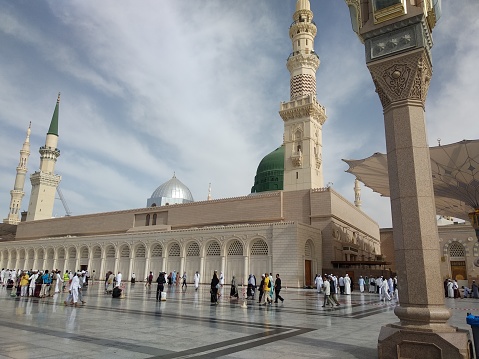
Madinah holds a different kind of pull. It is the city where the Prophet Muhammad lived, where the first Muslim community was built, where the most sacred mosque on earth stands over his resting place. To stand there is to stand in the footsteps of the man whose life gave the faith its shape. For the devout, it is not a metaphor. The emotion of arriving in Madinah — of seeing the green dome for the first time — is something pilgrims struggle to put into words. Men who have never cried in public weep without shame. Women who consider themselves ordinary people feel, in that moment, anything but ordinary.
This is why the waiting lists exist. This is why a person in rural Bangladesh will save for fifteen years for a single Umrah trip. This is why a grandmother in Kashmir will tell her grandchildren: if I manage nothing else, I want to manage this.
And this is why — scattered through Islamic scholarship, embedded in countless stories of the righteous — you find the tradition of hoping to die there. Not from despair. From love. From the belief that the most merciful of endings would be to be taken by God in His own sacred geography.
Die in Mecca, and be forgiven. Die in Madinah, and rise under the Prophet’s intercession. These are the whispered hopes of generations.
And Then There Are the Ones Who Cannot Leave
Here is where the irony folds in on itself, quietly and devastatingly.
Consider the pilgrim who finally makes it. After years of saving. After filling out forms and booking packages and convincing reluctant family members that yes, the money is there, yes, the time is right. They arrive. They perform their tawaf — seven circuits of the Kaaba, each step a kind of prayer. They stand at Safa and Marwa. They sit in the Rawdah of the Prophet’s Mosque in Madinah, in a space so sacred that the Prophet himself described it as a garden from paradise.
They do everything they came to do. They weep with gratitude. They pray for their parents, their children, their communities. They ask for forgiveness. They carry home supplications for every person who asked them to pray on their behalf.
And then — through no fault, no failing, no sin of theirs — they cannot leave.
A flight is cancelled. Then another. The airport is disrupted. The region is in turmoil. The airline has suspended all services. Alternative routes cost more money than they have. The hotel room that was booked for fourteen nights has now been occupied for twenty-five, and the money meant for a month’s groceries back home is going toward one more night’s accommodation in the most sacred city on earth.
What do you call this?
Blessed and Stranded. Both at Once.
There is no simple word for it in any language, because it is genuinely two things simultaneously.
The stranded pilgrim is, objectively, in the most spiritually elevated place a Muslim can be. Every step in Mecca carries reward. Every prayer in the Prophet’s Mosque is said to be worth a thousand prayers elsewhere. The scholars say: even the distress you feel in those sacred precincts is not without spiritual value. To be patient — to exercise sabr — in the shadow of the Kaaba is itself a form of worship.
There is a lens through which the stranded pilgrim’s predicament looks like an extended gift. More time in the holy land. More prayers. More tawaf. More mornings waking to the Fajr Adhan from the Grand Mosque, a sound that most Muslims will hear in their lifetime, if they are lucky, perhaps once or twice.
And yet the human heart is not a calculator of spiritual credit. It is something messier, more honest, more urgent.
The stranded pilgrim is worried about their family. About the relative who is sick and needs them home. About the job they need to return to, and the understanding that their employer’s patience is not infinite. About the elderly parent at home who is also unwell and was counting the days until their child returned. About the medication that is running low and is not easily available in an unfamiliar pharmacy where they do not speak the language. About the simple, aching, animal longing for the familiar — their own pillow, their own kitchen, the sound of their own language in the street outside.
These are not failures of faith. They are expressions of humanity. And the pilgrim who is desperate to return home while sitting in the holiest place on earth is not less pious for feeling them. They are simply fully human.
What Fate Has to Say
Every faith tradition grapples, sooner or later, with the question of why the pious suffer and why blessings arrive in forms we did not ask for.
The stranded pilgrim — blessed in geography, burdened in circumstance — is a kind of living parable for this question.
They did not fail to reach the holy land. They did not squander their time there. They fulfilled every duty they came to fulfil. They were ready to leave with gratitude, as every guest eventually must. And then something beyond their control — the missiles of a regional conflict, the grounding of a fleet, the cold mathematics of airline suspension notices — held them in place.
What do we make of this?
One answer — the easy one — is to say: God is testing you. Be patient. Be grateful. You are, after all, in the most blessed place on earth.
This is true. And it is also, for the person living it, not nearly enough.
Because the deeper truth is that being in a sacred place does not make hardship sacred. The Kaaba does not lower the hotel bill. The Prophet’s Mosque does not make anxiety go away. The most beautiful spiritual geography on the planet does not prevent a human being from feeling afraid, exhausted, lonely, and desperate to see their family.
And perhaps — perhaps — this is the actual spiritual lesson, the one that is harder and more honest than “be grateful you are there.” The lesson that holiness does not exempt you from difficulty. That faith is not a shield against the ordinary pain of being human. That even in paradise — especially in paradise — a person can ache for home.
The Millions Still Waiting and the Few Who Would Give Anything to Leave
Here is the final, sharpest edge of the irony.
Right now, in cities and villages across the Muslim world, millions of people would give almost anything to be exactly where the stranded pilgrim is. They are saving. They are applying. They are waiting on lists. They are in the third year of a five-year saving plan. They are older than they planned to be when they finally go. Some of them will not make it — time, money, health, circumstance will conspire against them, and they will die having never seen the Kaaba, never stood in Madinah.
They would trade places in an instant.
And the stranded pilgrim — bone-tired, financially stretched, missing home with an almost physical pain — would also trade places in an instant.
This is the peculiar grammar of human longing: we always want most urgently what we do not have. The man who has never seen the Kaaba longs for it with his whole heart. The man who cannot leave it longs for his own front door with the same whole heart.
Neither longing is wrong. Both are entirely human.
A Prayer That Runs in Both Directions
There is something beautiful, actually, buried inside this irony — if you are willing to look for it.
The pilgrim who desperately wants to go. The pilgrim who desperately wants to return. Both of them praying. Both of them yearning. Both of them, in their longing, fully alive to what matters most to them.
Faith. Family. Home. The sacred. The ordinary.
Maybe these are not opposites. Maybe the person who longs to reach the holy land and the person who longs to leave it are both, in their different ways, expressing the same thing: that human beings are creatures of profound attachment. To place. To people. To the particular combination of sounds and smells and faces that constitute, for each of us, the word home.
Mecca is home to the soul of every Muslim on earth, in a way that transcends geography. Their actual home — the room they grew up in, the city they know by heart, the family that waits — is home in a different way, a way that no amount of spiritual elevation can fully replace.
The stranded pilgrim is caught between two homes. And aching for both.
To the One Still Waiting to Go — and the One Waiting to Return
If you are the person who has never been, who is still saving, still waiting, still whispering that prayer in the early morning dark: do not lose hope. The longing itself is a form of worship.
If you are the person who went, who fulfilled every sacred duty, and who now finds yourself stranded in the most envied place on earth, unable to come home: your patience is not invisible. Your difficulty is not meaningless. And the home you are aching for — the ordinary, imperfect, irreplaceable home — will be there when you finally arrive.
The holy land will always be there too.
Both are waiting for you. In their different, irreplaceable ways.
“And it is He who made the earth for you, and the sky a structure, and formed you and perfected your forms — and provided you with good things. That is Allah, your Lord. Blessed is Allah, Lord of the worlds.” (Quran, 40:64)
Follow Us on WhatsApp
Get Breaking News, Exclusive Updates & In-Depth Analysis from Kashmir and beyond, delivered straight to your phone.
Join our WhatsApp Channel: Follow Now